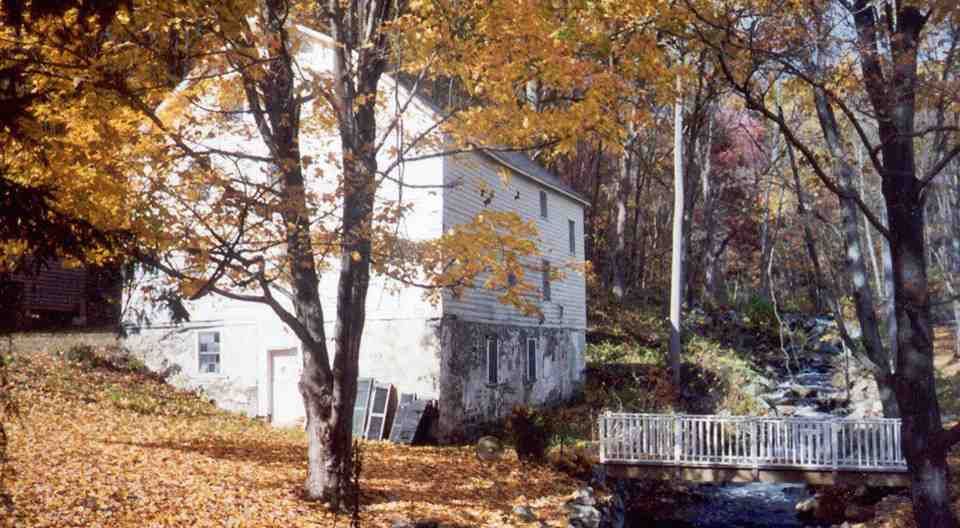
One of the side benefits to working with old barns is that they were often the repositories of old things. Interesting old things. This series of articles is on the old things that we come up with in our barn work. Take this old box for example. More properly, I should call it a chest.
Being in a barn, I would have thought at first glance that it was an old tool chest. But let’s look more closely, and maybe we can do some detective work together and possibly find out what kind of life it led before winding up discarded in an old barn.
Let’s look at the outside first before we venture inside. The first thing we notice is the paint. It’s now faded and muddied, but at one time it was a pretty powder green, not the kind of color a workman might paint his toolbox.
Next we see that the top and all the sides and bottom are single-width boards, not two or more boards glued together. Their tight grain indicates they were cut from virgin pine trees growing before the first settlers arrived. Is it an old box perhaps from the late 1700’s!?
Next we notice that the hinges have been moved. They were originally mortised into the top and back boards. Opening up the lid, we see the reason why. The old screw holes are wallowed out from use, and when we take the old iron hinges off, they still don’t match the original holes.
This is a good sign in a way, because these steel hinges are not old. They date to only the early 1900’s. This box would have had hand-forged hinges if it was as old as I think it is.
Looking around the top edge of the box lid, we see that the lid does not cover the box completely. It comes up short of the sides.
Looking closer we also see some unusual round holes with rings around them. It seems that they were made by brass tacks with round heads that held fabric or leather on the top of the box, probably a stuffed cushion so a person could sit on the box, and this stuffing would bring the size of the top out to meet the edges of the sides.
Now a closer look at the inside to see what secrets it will reveal: It’s lined with a faded pink fabric. But the fabric is tacked in place and overlies the original hinge mortises, therefore it is not original, but a clue just the same to the mystery use of this box.
And there is a box with a lid on it built into the end of the chest. Its lid pivots on two wood pins that are extensions of the little box lid itself, indicating that this box had to be in place when the chest was first assembled. It is original, indicating this is a more delicate chest than a man’s tool chest. And it does not show the signs of wear like you would expect from a tool chest. Its use all along was more delicate.
And there is another small box in the bottom of the chest, unattached. But when we pull back the fabric from the sides of the chest, it reveals two cleats on the side that this other small box neatly fits into and slides on.There you have it. Two small boxes in a chest. Both original. And, there is something else here. A number “2” written on the side of the second box. It is written in a red marker common to the 1830’s. We see this kind of marker used by carpenters in barns from that period, and it seems to be original to this box!
Back to the outside for some more clues. Turning the box over, there are four steel rolling casters, one attached to each corner of the bottom. But as you can see from the photo, they are not mortised into the bottom. I surmise they are a later addition, as they have ball bearings, and the craftsmanship does not measure up to the original maker’s dovetails.
So what kind of base did this chest have, or did it just sit on the floor? Let’s look at the outside base edges.
Here we see the ghost of a missing board that once was attached around the base of the chest. The green paint ends at the line where this base board was attached. Then turning the chest back over again, we get two more clues to the chest’s use: A safety pin and an early, mother-of-pearl button fall out of the chest!
So, our old chest wasn’t a tool chest after all. It was a sewing chest kept in the house. During long winter days it saw much use, until one day, it finally wound up out in the barn, empty and forgotten until . . . .
I am often asked the question of where we get our barns. When I reply, “Mostly from New York,” I am then asked, aren’t there good barns in other states?
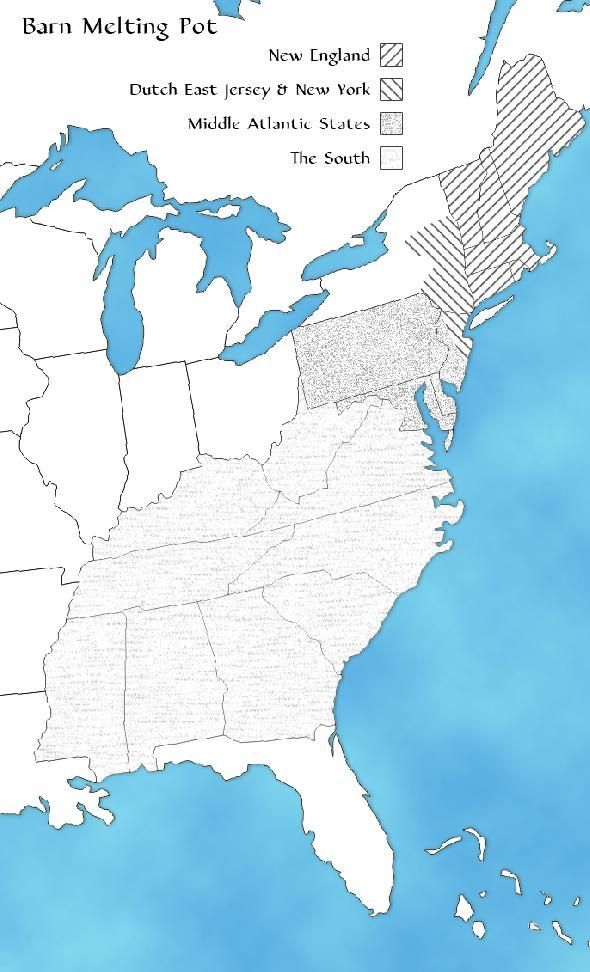
To answer this question takes a history lesson. First, there are proportionately few barns in the western United States that are timber-framed. This is because the Westward movement in the U.S. coincided with the advent of the Industrial Revolution in the 1800’s. As America industrialized and sawmills took the place of hand-hewing in the building of timber frames, there were fewer and fewer handcrafted, heavy timber frames built as settlers moved west. So the largest concentration of good, old timber frames is in the east. And since the warm climate of the south was not conducive to long life in wooden farm buildings, and the warmer southern winters did not require farmers to necessarily have large barns, this left the biggest and best East Coast barns in the northeast.
And the northeast had its divisions, too. Let’s include in this region the New England states of Massachusetts, Connecticut, Rhode Island, Maine, New Hampshire and Vermont (originally known as the “Hampshire Grants”). Also in the northeast are the Middle Atlantic States: New York, New Jersey, Pennsylvania, Delaware and Maryland. Below this are the southern states beginning with Virginia (though some would argue that the south begins with the Mason-Dixon line and therefore part of New Jersey is in the south, too, and Cape May, New Jersey, is south of Alexandria, Virginia!).
Moving back north again: Barns in the New England states are just that— English, with few exceptions. New England was settled by Englishmen who early on excluded foreigners from their colonies and even shunned other Englishmen who did not conform to their Puritan beliefs, like the Quakers, who, under William Penn, settled Pennsylvania, and the Catholics who settled Maryland.
Pennsylvania, Maryland, Delaware and West Jersey were also largely settled by Englishmen, with a smattering of Germans. This leaves the colonies of East Jersey and New York, where we get most of our barns. This region was settled in the 1620’s, not by the English but by the Dutch. And the Dutch allowed many nationalities to immigrate to what they then named “New Netherlands.” Aside from Dutch there were French Huguenots, Swedes, Jews, Walloons, Scots, Germans and others. And many brought their different timber-framing traditions to the Hudson and Mohawk Valleys and northern New Jersey (known in colonial times as “East Jersey”).
Combine this old world timber-framing talent with the virgin forest of this region, and you have the grandest barns ever built. And that’s where our barns come from.
In the fall of 1609, English explorer Henry Hudson sailed up the river that would later bear his name.
He was in search of a westward passage to Asia, but as the water sweetened and became less salty, it became clear to them that this was not the passage they were seeking. It was fine land though, and he claimed it for his patrons, The Dutch West India Company.
In 1624, the Dutch returned to the valley and began two settlements, one at the mouth of the river, which they called New Amsterdam,
and the other at the furthest north reach that Hudson sailed to, which they called Fort Orange.
Courteousy of lftantillo.com
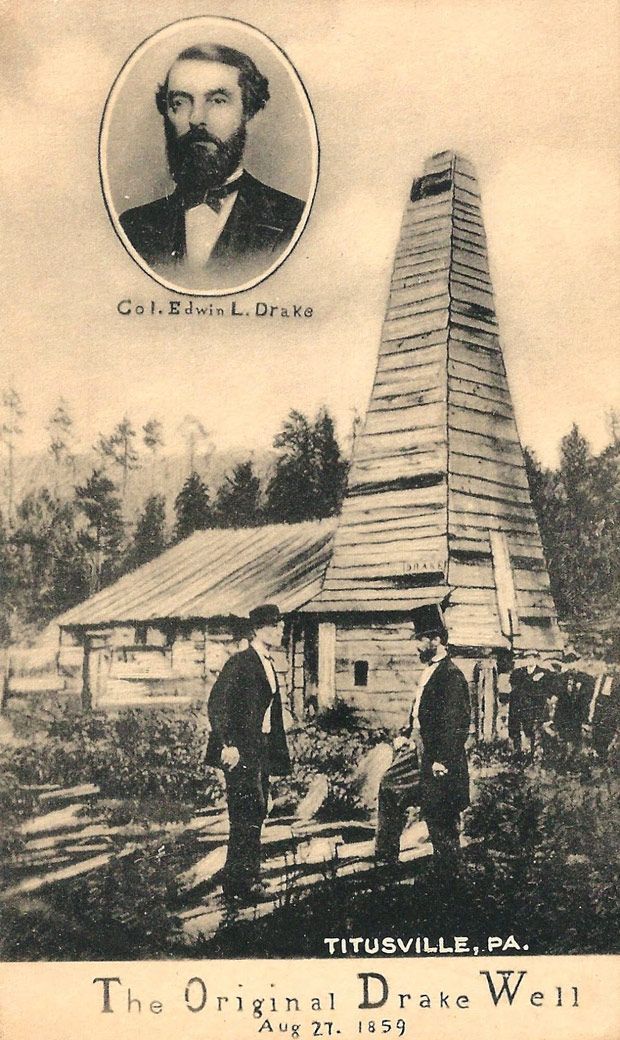
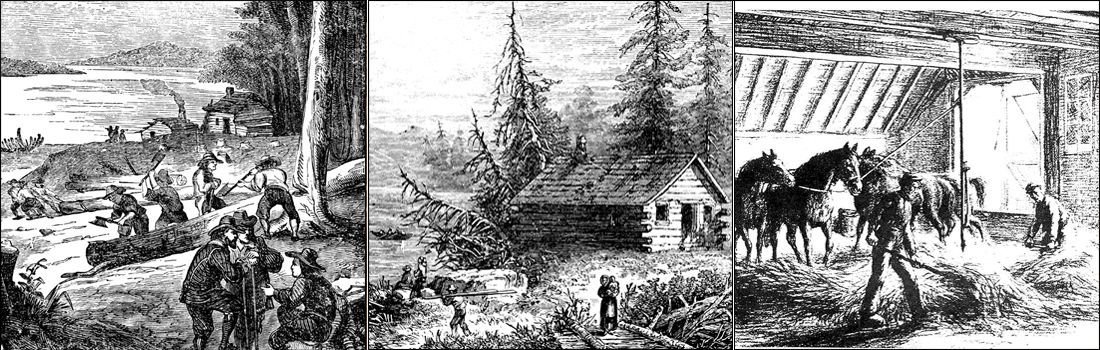
Not only did these settlers find a rich and fertile land, they found forests with enormous trees of hard, dense, tight ringed wood that had never felt the bite of the iron axe. And not only did these giants of the forest serve them well in their own buildings, but their lumber was prized in European countries that had long been settled and deforested.
To tame this wilderness and fell these trees was a challenge that at times proved fatal to these inexperienced settlers. David Demarest, the first settler to cross the Hudson from New Amsterdam into what is now Northern New Jersey was tragically killed when felling one of these massive trees for his family’s new home.
But the challenge proved rewarding despite the dangers. Felling and hand hewing timbers from this virgin forest, the first settlers built barns and homes unlike any they were able to build in Europe. Instead of piecing short timbers together, they could hew straight beams forty, fifty and even seventy feet long.
Not long after these first Dutch settlers arrived, the political wars of Europe spilled over to the New World and in 1664 the Dutch were forced to cede their colony to the English as a spoil of the Thirty Years War that had been fought on the European continent. The result being that the Dutch settlements of New Amsterdam and Fort Orange were renamed proper English names: New York and Albany.
The English also recognized not only the beauty of their new colony, but also the natural riches, especially the trees, of which they had a particular need. The Royal Navy was in desperate need of not only timbers for their ships, but also of Naval Stores such as varnish, tar, pitch and turpentine. They hoped these resources could be gotten from the massive Eastern White pine trees of the region. To help accomplish this, the English turned to their allies, the Germans, who provided 5000 settlers from the Palatine region and sent them over to the New World in 1710. The experiment would soon fail however, when the English realized that the Eastern White Pines did not produce a sap satisfactory for making naval stores, at which time they released the Palatine Germans to settle in the colony wherever they could. They pushed westward up the Mohawk River where they came to yet another river, which they named the Schoharie. It too was a fertile valley surrounded by high mountains.
It was here that Hartman Winedecker brought his family and built his home in 1713. Though he brought with him the customs of Germany, he chose to build his barn like those of the Dutch settlers in the region. Unlike the English barns, the architectural style of these barns dated back to the eleventh century
All was well for the Winedeckers for their first fifty years on the frontier. This new land was good to them, and their massive-framed barn held all that the family needed, including abundant wheat harvests…
that is until another political dispute broke out, this time between the English and their colonists in America. Soon a full-blown Revolution was raging in the thirteen English colonies and the wheat of the Schoharie Valley was a valuable asset to the American troops under General George Washington.
Then in October of 1780, just when the harvest had been gathered into the barns, the British and Indian allies under the notorious Indian leader Joseph Brandt struck the Schoharie Valley.
Joseph Brant
These raiders spared nothing in their attempt to cut off the grain supply to Washington’s continental army. Six hundred homes, barns and outbuildings fell to their torches…except the barn of Hartman Winedecker’s. Somehow it was overlooked or bypassed.
It would not only survive the American Revolution, but it would see the Revolutionary soldiers it sheltered live on to found a new nation. The Valley grew as new settlers came and Indian raids ceased. The opening of the Erie Canal in the 1820’s would transport grain stored in Winedeckers nearby barn as well as hundreds of thousands of pioneers heading westward via the Canal to the Great Lakes of the Midwest.
Civil War with its Southern brothers sundered the nation, followed over the next nearly century and half by seven more foreign conflicts.
Ultimately it saw use for another two centuries after the American Revolution until another Revolution finally caught up with it: The Industrial Revolution. In the 1970’s it fell victim to new mechanized improvements in agriculture, and its subsequent years of obsolescence neglect were more wearing on it than two and a half centuries of daily use.
By the year 2007, it was in need of a new lease on life. And that is when Heritage Restorations arrived to carefully dismantle and restore it to its original glory.
Now this survivor of centuries and wars lives on, appreciated everyday by its new owners for its simply hand-crafted beauty and incredible history.
Men Of A Different Sort
We just completed another timber framing class here at Ploughshare in which we built a new timber frame of a 24 x 24 building.
This is a three-day class that has bit off more than it can chew in three days and which we need to expand to at least five days. The class calls for a lot of hand joinery, that is, hand-chiseling and sawing. What all of us notice in this class is how sore everyone is after a day of this kind of work, so the conversation inevitably evolves to comments about how strong those early timber framers were and, even further, what kind of people they were.
Image Courteous Of Toolemera.com
Who Were They?
In answer to these questions, we know that timber framing was not for the weak of heart or muscle, probably reflective of the trade of house stick framing today in which it is rare to find an old man or a weak young man. Before the age of mechanization, (i.e. saw mills) there were no short cuts, and it appears from the quality of the timber frames extant from this pre-industrial time, care and quality ruled. The mentality prevailed that if you were going to do it, you may was well do it right, and this adage equated to longevity.
The question is often asked, “Who were these men?” and “Did the farmers build entire frames themselves?” I will offer an answer to this question based on my experience and knowledge, but open to whatever anyone else may venture. Prior to the industrial age (c. 1800) and the heavy settlement of the original colonies in America, we were a country of 98% yeoman farmers. Considering all the other trades, this did not leave much room for a large pool of free-lance timber joiners. And I think that most timber frames, which included all types of buildings, were built by the local farmers for their own farms, perhaps with help from their more experienced neighbors. (This was also supplemented by slave labor both north and south, remembering that northern states not only had slavery, but in some cases more slaves, as in the case of New Jersey, than many southern states.)
The art of joinery was, out of necessity, known and practiced by most farmers. It took just a few tools: axe, saw, auger, string line, knife, or some sharp metal object, sharpening stone, mallet and chisel. An adze and slick would also have been helpful. And some of these could have been borrowed from a relative or neighbor. So, it was these farmers who built their own timber frames . . . with some neighborly help. Perhaps this is evidenced in the wide variety of sizes of barns and homes and how no two are identical. This may come as a surprise to us moderns, but only because we have lost so much of our “handy-ness” and common sense, that was in such abundant supply with our ancestors.
But with the advent of the industrial age came its hand-maiden: specialization, something that was first more common in Europe. With industrialism, all trades began to exit the home and splinter into specialists. The cloth making art fragmented into spinners, weavers, fullers and dyers. And with time, husbandry abandoned its diverse roots and farmers specialized their crops and livestock: dairy men, orchard men, grain. Mono culture was ultimately approaching on the horizon. And the art of timber framing specialized into the joiner’s trade.
The way the business evolved, would probably be similar to what we have today when a homeowner contacts a carpenter to remodel his home. A farmer would seek out a joiner, whose reputation in a localized society would probably already be well-known to him. And they would strike a deal. Very often, the farmer would fell the timber from his woodlot and sled them down to the building site in the winter. He may also take the timber frame building process to the point of hewing the timbers square, leaving the joiner to cut them to length and fashion all the joints.
The joiners also had apprentices, sons or helpers who accompanied them. But always the master joiner called the shots. The successful outcome of the frame was solely his responsibility.
Old World Meets New
More than any other factor, what differentiated American timber framing from its predecessors in the Old World was when the Old World pioneers came to America, they were confronted with a very different building reality in that the materials they had on hand to build with, namely trees, were vastly different from their experience in Europe. By the 1600’s many European countries like England, Ireland and Holland had been deforested. And though there was a tradition of timber framing, they had by this time, very poor quality trees to work with. For this reason they employed even the short and unstable crooks of trees in their buildings, a practice that became unnecessary in the New World.
Where had all the mighty English oaks gone to create this shortage of timber? Literally, up in smoke. This was before the age of coal-burning and wood was used for heating and cooking, as well as home building and wooden shipbuilding.
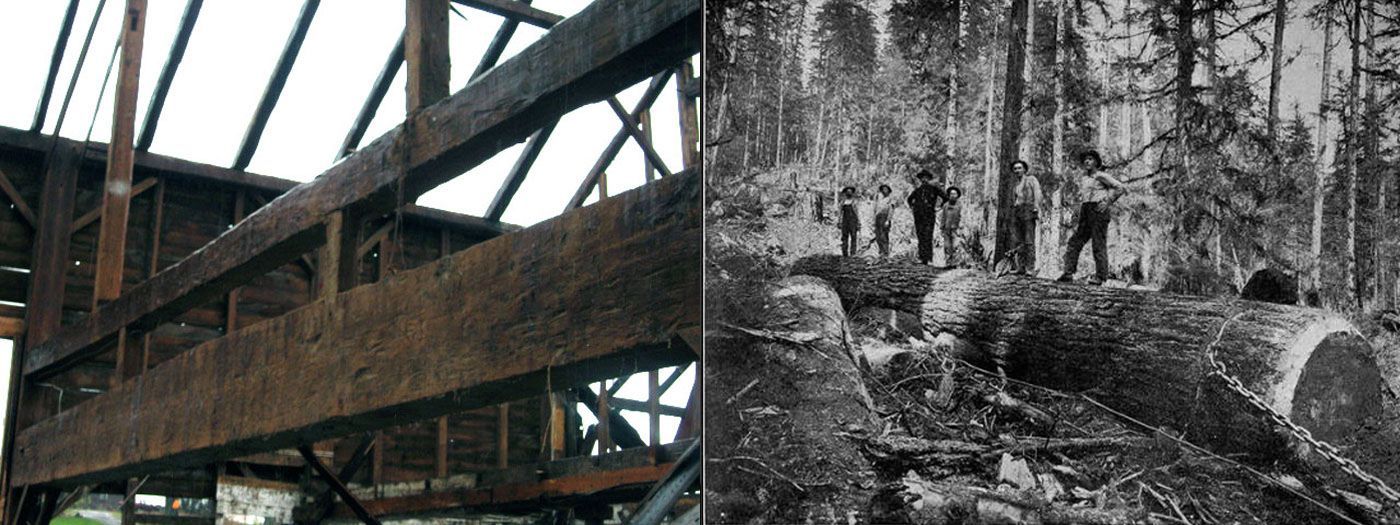
In our years of restoring historic timber framed barns, this hand hewn hemlock timber is the largest we have ever seen. It is part of a barn built in the Mohawk Valley of New York state circa 1840.
The timber is 35 feet long and measures 13” thick by 28” at the widest point. That’s well over 900 board feet of lumber in a single beam.
After over 165 years of natural air drying, this beam weighs around a ton. When it was first cut green using only simple hand tools and transported with horses, it likely weighed over 3500 pounds!
Counting the tightly spaced growth rings, we determined that the tree from which this timber was hewn was around 300 years old when the early American farmer cut it to build his barn. It was a towering 100-year-old hemlock when the Pilgrims landed in Plymouth harbor in 1620.
Through Their Eyes
Can you imagine the awe these settlers to the New World felt when they arrived and saw the virgin American forest? They were probably stunned . . . and intimidated. The New World forest contained straight trees over one hundred feet tall: pines, hemlocks, oaks, chestnut (which was said to have made up one third of the northern forest), maples and beech, just to mention a few of the species. And sometimes this difference between New and Old World trees had deadly consequences. The first permanent settler to Bergen County in Northern New Jersey in 1670, David Demarest, lost his namesake and oldest son to a falling tree soon after they arrived. The Demarests had immigrated first to New York from the low country of Holland and prior to that were persecuted Huguenots in France. They had probably never encountered a forest when they began to build their homes and barns on the bank of the Hackensack River.
So here in America converged a unique combination: skilled European wood craftsmen and an untouched, virgin forest. And when the two were combined, they produced for a period of time, the finest and largest barns ever built in the world, during what we might call the “Golden Age of Barns,” before the Eastern forest was clear cut to make way for agriculture and industry, and the Industrial Revolution brought an end to the art of timber framing in America.
Historic Barn before being moved
Historic Barn after moving and restoration
To Move or Not To Move?
As the founder and owner of a commercial barn preservation company I have operated on the premise that through our barn preservation work we are striving to save America’s architectural treasures from demise and destruction. I recently realized, however, that my lofty opinion of our efforts is not held in common by all other preservation lovers. This poignant realization dawned on me when I tried to join a prestigious (and apparently exclusive) Northeast association dedicated to preserving local architecture. Last year I contacted the Association and dutifully sent in my $20 annual dues at which time I expected to be installed as a full-fledged member in good standing. I even contacted one of the officers and offered my help in any way that might be needed in their crusade to save local architectural treasures.
I awaited the arrival of my first issue of the Association’s quarterly newsletter, informing me of upcoming events, which I planned to attend: house tours, symposia and the such, that all admirers of local historic architecture cherish, especially when it comes to meeting other like-minded history buffs.
All was well thought well between me and my new-found friends in the Association. . .UNTIL I mentioned to them that I had a good deal of experience moving historic barns and restoring them. It now seems that the “restoring” of barns is not what irked them. It’s the “moving” of barns that they find so odious.
As of this date, over a year after paying my membership, I have not received any newsletters and my calls to the Association have apparently been ignored. I take this to mean that, despite the fact that I have saved dozens of barns from the wrecking ball and given them new life, I am not accepted as a member in good standing after all, and would go so far as to say that I am persona non grata in the halls of the Association, my name having apparently been duly struck from the membership role (though I am certain my dues were put to good use).
This personal anecdote is representative of the controversy in the historic preservation world that our barn restoration work cannot help but to be at the epicenter of, whether we like it or not. That is the question of whether it is ethical to dismantle and move a historic building like a barn. The opposition we get on this is that barns belong where they are. They are part of the local history, and to move them is to rob the local community of their heritage. This controversy has gone on for some time. The British Museum with its Elgin marbles has some serious competition from American industrialists and entrepreneurs when it comes to raiding historic architecture, which is (perhaps in its darkest hour in America) exemplified by Henry Ford’s plundering of America’s historic industrial sites like the Wright Brother’s bicycle shop and Edison’s Menlo Park Lab, which he dismantled and carted off piece-by-piece to Michigan.
Another, more recent example is the stone-by-stone removal of the 1831 London Bridge from its home on the Thames to Arizona. It was on London’s bridges that the heads of yeoman farmers-turned-paupers were publically displayed, executed for opposing the enclosure laws that expelled them from their ancestral agricultural lands and homes to make way for sheep herds and the coming industrialization of the textile trade. The bridge is now the centerpiece of a kitschy waterpark over a manmade lake in the middle of the desert. If those peasant heads were still hanging there, their eyes would probably roll every time a bathing-suit-clad jet skier streaked by.
A Deeper Dynamic?
Despite this ignominious history of plundering historic architecture by well-heeled individuals, I counter the argument against our barn moving by saying that concerned, local preservationists are just as capable as we are of restoring barns, and they should put their actions where their sentiments are by doing something about these barns that are falling down, like London Bridge was, and literally becoming compost piles. But I also sympathize with these local concerns and believe that what is at the root of this problem is a much deeper dynamic:
Agriculture in America has taken a direction that makes traditional barns obsolete. It went industrial and BIG along with the rest of the economy. Tens of millions of families were forced off their farms over the past one hundred years because of the Industrial Revolution and its handmaiden, the Transportation Revolution. Yes, I agree, communities need their historic buildings. These structures are the visible links to our past that offer a tangible stability to every community. And that is why we preserve them. Our company policy has always been to defer to any person or historic preservation group who would restore a barn in place that we had planned to move.
We are sometimes challenged on this issue specifically by barn enthusiasts. But, in fact, we have done more to preserve barns than most anyone in this country. We have moved and restored over one hundred and fifty barns that through our business efforts have found new homes in the hands of very appreciative new owners, though most times in places where the public cannot gain access to them (not that they could access them when they were hidden away on private farms). An interesting footnote to this controversy is that about a third of the barns we dismantle have already been moved at some point in their history. Whether sold to the farmer up the road or across town, they were moved largely because farmer Jones no longer needed the barn and farmer Smith did. Not unlike the reason we move barns for people today. So, I argue that in moving barns we are not doing anything out of the ordinary, and such moves are part of their continuing story, another chapter to be written by another family in another place. Can this continuity be argued with? We are simply carrying on the tradition.
In the meantime, I encourage everyone to join their local preservation associations. These are dedicated, well-meaning people who love their local architecture and communities and are working to preserve them. . . . But don’t mention my name when you do. You may never see your $20 again!
Kevin Durkin
Not all Barns are created equal. . . .
And this is not always self-evident
One of the questions I am asked most frequently is: “How can you tell a good barn from a bad barn?” My answer to this question is that you must look at each barn carefully with an eye to a combination of history, craftsmanship and plain ole wear-and-tear, and you must have a trained eye to do it.
In our work we have looked at hundreds of barns over the years and have found that there are good barns and there are bad barns. There are barns surviving today from the age of hand-craftsmanship and there are barns that are products of the Industrial Revolution, during which time the methods of building barns shifted from quality hand-craftsmanship, meant to last centuries, to what we have come to identify as the planned obsolescence of the industrial era of the last two hundred years or so.
When barns were timber-framed in America during the 1600’s and 1700’s, they were intended to last for centuries. This means that the owners wanted a heavy timber frame protected from the elements by the roof and siding. Even though they knew the roof and siding would wear out and be replaced many times, and even the flooring would be pulled up and replaced, the core timber frame would remain.
So there are features to look for when buying a barn to be converted into a home. Here are some important ones:
Age: Generally speaking, the older a barn, the better it was crafted and the larger the timbers. This also means that the parts of the country on the East Coast that were settled earliest tend to have the oldest and nicest barns. But this also means that the older a barn is, the more it has been subjected to wear and tear, which brings up the subject of condition.
Condition: Even a well-crafted barn can have been neglected to the point of no return at which time it is not worth salvaging. The most important feature determining the condition of a barn is the roof. If the roof is intact and does not leak, it is likely that the barn under it is in good condition. On rare occasions, barns were neglected in the distant past and then given a new roof that then hides old rot. An experienced eye can determine this with some probing.
Joinery: A joiner is the person who cuts the end joints of beams into tenons and carves out the mortises, or squared holes, for these tenons to fit into. This is known as mortise and tenon joinery. (The fact that the spell check on my computer does not recognize “tenon” as a word, is proof of how the ancient process of hand joinery has been lost.) The quality of tenons, how tight they fit and how squarely and carefully they were shaped, is a direct reflection of the quality of a barn since it was a skill that could only be acquired with practice and a good teacher. As time passed into the later 1800’s, the ancient art of mortise and tenon joinery was replaced with mechanical fasteners, spikes, bolts and plates. Finally, the heavy timbers themselves were replaced with smaller “dimensional lumber” like 2x4’s that were nailed together. So, with the passing away of hand-joinery went the ancient craft of timber framing.
Wood species: Barns were invariably built with the woods from trees that were closest at hand. Generally, there are soft woods (hemlock and pine) and hardwoods (oak, chestnut, beech, poplar, maple). All of these woods make good timber frames. The hardwoods generally were made into lighter framed barns (timber dimension-wise) and the soft woods were more massively framed.
Hand-hewn or sawn: The great labor in building a barn was in turning living trees into stable, square building timbers. This task could be accomplished mainly in two ways or in a combination of both. 1) The ancient process of felling a tree with an axe, and then using the axe to chop away the tree into the shape of a square beam was very labor intensive. This process is known as “hand-hewing” and was one of the first tasks that the industrial age tried to eliminate with a machine. And 2) the machine they invented was the saw mill. First the straight-cutting, vertical saw and later, about 1835, the circular saw. Prior to saw mills, there were hand-saws, but their use was limited to cutting tenons, cutting beams to length and in the case of a pit saw, sawing logs into boards.
As time progressed and sawmilling began to overtake and replace hand-hewing during the 1800’s, more and more barn timbers were sawn on mills, beginning with the smaller lengths like the knee braces, since they were most easily gotten to a saw mill. The longer lengths, like the huge top plates, were the last to be saw on mills since they were simply of unmanageable length and difficult to transport to a sawmill.
Once piece plates: the longest parts of a barn frame are the plates. There are two kinds of plates in a barn: top (resting on top of the side walls) and purlin, (supporting the rafters from underneath about in the middle of their length.) The plates run the length of a barn, and in earlier barns they were often one-piece, hewn from single trees. And these could be as long as sixty or even seventy feet!
As trees of such quality and length became rarer and sawmills preferred to cut shorter timbers, plates were sliced with joints called scarf joints. And as quality declined into the late 1800’s, mere “lap joints” joined plates end to end to make up the length of a barn.
Critters: it has been our experience that all barn frames have some current degree of bug infestation. The most pernicious of these critters is the powder post beetle, which defy all but the most complete treatments. To deny their presence is wishful thinking. To buy a barn that has not been fumigated properly is looking for trouble. Once built into a house, these pests have a way of making their presence known and are very expensive to get to move out. Don’t make the mistake of buying an untreated barn frame.
So, there you have a brief primer on what features to look for when barn shopping.
Many of the old barns we disassemble and restore for homes were built in the 1800’s with hemlock timbers from New York State. Eastern hemlock (Tsuga Canadensis) is a conifer once widespread in the mountains of the Northeast making up a large portion of the virgin forest. They were massive, straight trees and by counting back their growth rings, we can date these trees back to when they first started growing as early as the 1500’s.
But unlike the eastern white pine that also grew abundantly in the region, hemlock trees were prized primarily for their bark. Hemlock bark is high in tannic acid, which was used to “tan” hides for leather in the early 1800’s.
In order to obtain the bark for the tanning mills, the log cutters and bark peelers would peel off the bark and leave the tree trunks behind as waste by-product of this early American industrial process. Then, in the wake of the tree cutters came farmers who recycled the logs and hand-hewed them into beams for their homes and barns. It is estimated that as many as 70 million hemlock trees were cut for their bark. Not only did the tanners clear cut whole forests, but tanneries also needed water for the tanning process and so were located along streams that they also conveniently dumped their spent tanning solutions into.
The tanning process often included using mercury and many a tanner and hatter, (as hats were made from tanned beaver skins) showed the effect of exposure to this heavy metal on their nervous systems, thus the origin of the phrase “Mad as a Hatter.”
So, not only were these hemlock timbers salvaged from old barns by us in the 21st Century, they were salvaged long ago after they had their bark peeled, so we can say they’ve been “twice recycled.”
All images used by permission of
Robert E. Sweeney and the Sullivan County Genealogical Web Page.
All rights reserved.
(We took on an unusual construction project at Heritage Restorations to build a cheese cave for Brazos Valley Cheese, another one of our Homestead Craftsmen companies. The finishing touch was a castle-like entry door into the cave made from our antique barn wood.)
An underground cave for aging cheese is the dream of most cheese makers. And so it was for us at Brazos Valley Cheese located at the Brazos de Dios community in central Texas. During the more than fifteen years we have been making cheese, we have talked about building a cheese cave with an old-world flavor that we could age our artisan cheeses in. Finally, last year, we began work on a new shop and cave, but the cave part was the first to be built since more aging space was our immediate need.
Up to this time we have aged our twenty or so different varieties of hard and soft cheeses in walk-in coolers. Aging cheese in Texas can be a real challenge especially in the summer when daytime high temperatures typically peak over 100 degrees, sometimes for weeks on end. Unlike building a cave at a more northern latitude, our ground temperature never gets low enough through the year to allow for a cave without supplementary refrigeration. But still, the advantages of a cave, versus a walk-in cooler, led us to break ground in November 2010 on the new cave. Though we researched other cave designs, we were somewhat on uncharted territory in a climate this warm, and knew that we would have to pay careful attention to insulation.
We expected to encounter rock not far beneath the surface and sure enough, at three feet down, we hit fractured limestone, which was easily broken up excavated to a depth of fifteen feet. The cave is basically a cement slab floor with cement block walls and an arched poured-concrete roof. This entire room was encased in a coating of closed cell spray foam with a vapor barrier covering it, along with French drains at the base and then back-filled and landscaped over. The interior measures 6,000 cubic feet and the interior walls have a stucco finish. The pine shelves in the cave hold 3,000 ten-to-twelve pound wheels of hard cheese. Thankfully, the temperature stays a constant 50 degrees with a rather moderately worked 2 ton cooler unit. And that’s in the heat of a Texas summer.
The cave will be accessible by an elevator inside the shop, in which we can lower carts of cheese. We will also have a brass fireman’s pole alongside the elevator to allow for a quick descent to the cave, instead of a walk-around to the stairs! For the public we have an insulated observation window at the bottom of the stairs, accessed from the outside of the shop. We topped the whole project off with a five-inch-thick insulated castle like door with its own skeleton key and wrought iron hinges that never fail to amuse visitors.

A small community near the Texas town of Elm Mott is a worthwhile trip ‘down the road on 35,’ whether you are a professional needing advice on sustainable farming or building practices, or a family seeking fun in an idyllic educational setting. Homemade pastries and lunch at an affordable price is a surprise bonus. Work and craft are practiced as art in this Hill Country setting...
Click here to read Stephen's full article on sustainable timber frame restoration.
While searching out barns for dismantling and restoration in the Albany, New York area, we have over the past four years come across what seems to be a unique and rare form of barn. The Dutch colony of New Amsterdam, later to become New York, was perhaps America’s first true ethnic melting pot, with a history of different groups immigrating to the colony from the time the Dutch first settled there in 1624. Unlike the English in New England, the Dutch were tolerant of many different ethnic and religious groups including French Huguenots, Palatine Germans, Sephardic Jews and Englishmen.
To this mix was added in the Albany area about 1780 a large contingent of Scots who settled to the west of Albany and Schenectady, New York in the Mohawk River Valley. Today this area comprises, not surprisingly, towns with names like New Scotland, Scotia, Perth, Pattersonville and Broadalbin. It was while searching for old barns in these towns that we first began to come across barns that differed from the typical Dutch and English barn framing that is so common in New York. What distinguishes these barns is that they have ridge beams supported by king posts. Otherwise, from the wall plates down, they have they resemble the framing of English barns.
The examples we have encountered all mostly scribe-ruled and marriage-marked and seem to date c 1780 on. There are a few variations in the way the rafters relate to the ridge beams: the rafter pairs are either mortised into the ridge beams or they are resting on top of them and joined by trunneled lap joints. The typical woods used are local hardwoods of beech and chestnut and the softwood, Eastern white pine. This also point to a pre-nineteenth century construction, before hemlock became the predominant building wood in the region. Roof pitches vary from 11/12 down to 9/12 and the ridge beams are square to pentagonal. Most all parts of the barns are hand-hewn with sawn braces being the exception.
Perhaps the grandest, largest and most unique example we encountered of what we call New World Scottish Barns was from Perth, New York with a footprint of 42 x 50 feet. From the outside, one would have thought he encountered a New World Dutch barn with its 11/12 pitched roof and nearly square dimensions. But the interior framing was an unusual mix of three king posts supporting a pentagonal ridge beam and queen posts supporting purlin plates, all in the same barn. The frame was predominantly beech and chestnut and scribe ruled with five bents.
Scotch Barn With Both King and Queen Post
It is my speculation that these barns are derived from the Scottish settlers to the area. It would be interesting to explore the later history of this barn form, if it moved west with the descendants of those first Scottish settlers into Western New York and Ohio the way the English frame did. But why they built this style of barn in the first place is not known, especially when one considers the difficulty of raising a ridge beam on king posts. Perhaps the Scots built barns this way because the English didn’t!
If anyone knows of any other examples of this type of king post barn in America or of the origin of these New York barns, we would like to hear from you.
Many years ago, choices for paints, sealers and other building materials did not exist. Farmers had to be resourceful in finding or making a paint that would protect and seal the wood on their barns. Hundreds of years ago, many farmers would seal their barns with linseed oil, which is an orange-colored oil derived from the seeds of the flax plant. To this oil, they would add a variety of things, most often milk and lime, but also ferrous oxide, or rust. Rust was plentiful on farms and because it killed fungi and mosses that might grow on barns, was very effective as a sealant. It turned the mixture red in color. When paint became more available, many people chose red paint for their barns in honor of tradition. (Farmers Almanac)
Heritage Restorations had the unique opportunity to raise one of our restored historic timber frames in Japan!
We dismantled and restored an 1840’s timber frame barn from the tranquil fields of upstate New York…
…and reerected it in the bustling metropolis of Tokyo, Japan.
Read the rest of this entry . . .