Mott Gristmill

Kevin Durkin


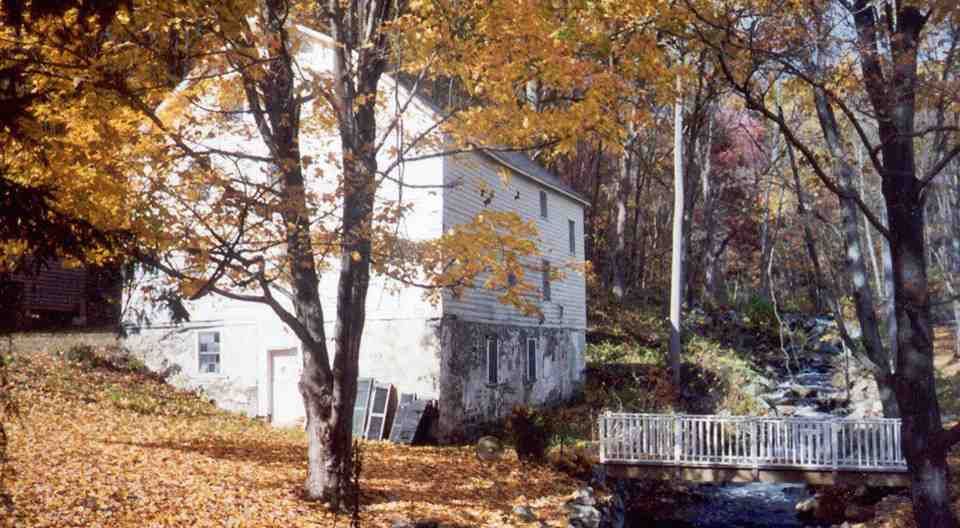
There is something about gristmills and waterwheels that resonates with just about everyone. The gristmill is an American icon that evokes sentiments of home and community, as is evidenced in the gristmill pictures so many of us have in our homes. Perhaps some of this sentiment was at the heart of our efforts in 1999 to relocate a historic working gristmill to our community in Texas. At the time we had an electric-powered mill running in a small outbuilding, but we wanted an authentic waterwheel-driven mill where we could grind the grains we grew into flour for both our families and our neighbors. So, the search was on, and it took us once again back to the East Coast where we tracked down an old, dilapidated gristmill in the town of Califon, New Jersey.

This area of New Jersey is not only noted for its rural beauty (New Jersey is, after all, “The Garden State”), it was also the scene of some of the most dramatic events in the American Revolution, events that, as we’ll see, were directly related to the Mott mill. When I first visited the mill, I was told that it dated to about 1820. But on closer examination we found that it was actually a much earlier gristmill that had been altered, as were many other mills during the transformative years of the early Industrial Revolution. We determined that the mill had been lengthened twelve feet and the roof raised a story. In October of 2000, we carefully dismantled the mill and shipped it to Texas. After moving the mill and re-erecting it on The Ploughshare campus as the Homestead Gristmill, we began to gather more information about its history. A land deed from 1768 is the earliest written record of this mill. The deed records: “Beginning at a large white oak marked for a corner standing near a small swamp on the southwest side of the brook below the mill . . . .” The deed was written when a German immigrant named Asher Mott decided to sell his share of the family property to his older brothers, John and Gershom for £ 1,000.

Further research revealed that John Mott was a patriot of some note. Living and running his gristmill in the Long Valley of west central New Jersey, he adhered to the patriot cause, and when the American Revolution broke out in 1775, he enlisted as a captain in the local militia. New Jersey is known as the “crossroads of the American Revolution,” as both armies traversed it several times.

In 1776 things did not fare well for General Washington and his army. He had been consistently outgeneraled and defeated by his adversaries, British generals Howe and Cornwallis, at the battles of Long Island, Manhattan, White Plains and Fort Washington. At Fort Washington he had watched from across the Hudson River as British troops surrounded his namesake fort on upper Manhattan and forced it to capitulate, sending all 4,000 defenders to prisons. As if this were not enough, the next week he was surprised by Cornwallis, who skillfully executed a night march and nearly succeeded in surrounding and destroying his ragged army. In their haste to escape, Washington’s men left their breakfasts boiling in kettles over campfires for the British troops to enjoy. Through a cold rain, Washington’s army retreated down the length of New Jersey to the Pennsylvania side of the Delaware River. By that time the army had dwindled to not many more than 1,000 tired, discouraged, hungry, ragged men. Cornwallis, leisurely pursuing Washington to the Delaware River bank, dismissed Washington and his rabble with the comment that he would “bag the fox in the morning.” Five years later, of course, “that fox” “bagged” Cornwallis at Yorktown, ending the American Revolution with this British defeat.

But at that point in 1776, Washington’s back was up against a wall, and he knew that he had to have a turn of events or all would be lost. So, taking a gamble, he planned a surprise attack on Cornwallis’s outpost across the Delaware River at Trenton, New Jersey. But to get across the river and through the countryside back roads at night required a knowledgeable, local guide. This is where Captain John Mott came forward. On the night of December 25, 1776, counting on the enemy being off guard after their holiday celebrations, Washington led his scraggly army—guided by Captain Mott—across the ice-flow-choked Delaware to capture the post at Trenton. They endured a grueling river crossing, a night march, a battle pitched at sunrise and a countermarch back across the river. Most of this time they were pelted by snow and sleet as they marched through a snowstorm in which many of the men did not have shoes, and the rags they wrapped around their swollen feet were soaked through with blood.

A week after the Battle of Trenton they again crossed the river to fight the Battle of Princeton, after which Washington led his army into winter camp at Jockey Hollow in Morristown, New Jersey, not far from Captain Mott’s gristmill. The mill undoubtedly served as a source for their flour for the rest of the war, including the winter encampments at both Valley Forge and Jockey Hollow. If you have ever visited New Jersey in the winter, you know that it is not the season for a camp out. The winter weather can be severe, ranging from cold rain to deep snow and often a combination of both on the same day. One can imagine the winter conversations that went on in the mill as they ground corn and wheat into flour, while debating which side would prevail in the conflict.

After the Revolution, John Mott went on to grind grain for the local community, and the mill passed through several hands during the 1800’s. It finally closed about 1920 when the post–World War I recession and competition from larger mills made it obsolete. Today, most all of the flour milled in America comes from five huge mills that use a steel hammer milling process that actually smashes the kernels.* Stone grinding has gone by the wayside, except at mills like our Homestead Gristmill where you can still get fresh, stone-ground flours.

Published in SustainLife Quarterly Journal of the Ploughshare Institute for Sustainable Culture (Fall 2012).


The Great Epizootic of 1872

An Example of Large-scale Vulnerability from the Past
Kevin Durkin

People often ask what interesting things we find in the centuries-old barns we dismantle for our barn restoration business. Well, there are a lot of interesting “things,” like the time we found an old pillowcase hidden in a corner of the first barn that we took down that was full of jewelry from a long-forgotten house burglary, and the time we found the bowling ball that my helper claims is the ball that old Rip Van Winkle used before he drank the potion that put him to sleep for twenty years in the Catskill Mountains. And there are also occasionally some very interesting writings, most often in the form of centuries-old graffiti.  About 1870, a black ink feed sack marker came into use that seems to have found its way into the hands of just about every boy and hired hand in that era. For the next twenty years they made it their off-hours pastime to write their names, dates and musings on barn interiors. Unlike the modern railway boxcar graffiti that we are all subject to while waiting for freight trains to pass through town, this barn graffiti was often scrolled in the most eloquent of nineteenth century scripts.
We recently found perhaps one of the more intriguing examples of such writing in a barn from the Mohawk Valley of New York. It read simply:

“Equine flu epidemic, October 10, 1872”

This example tweaked my curiosity, as I thought that if this was a significant enough epidemic to make note of on a barn wall, it might have made its way into the history books. So I did some speedy research and found that the 1872 horse influenza epidemic was indeed historic. But what I found most interesting is that this catastrophic event remains forgotten and entirely unknown to most of us today, probably because horses play such an insignificant role in our modern lives, unless, of course, you—like us—still depend on them for plowing and cultivating the fields which produce your food.

Horse flu is formally known as equine influenza. When a disease that affects animals reaches widespread proportions, it is known not as an “epidemic,” but an “epizootic.”  Equine influenza is a highly contagious virus occurring globally that has been known to infect up to 100% of exposed horses, though there is now an effective vaccination for it. Unlike swine flu or avian flu, it has not spread to humans in the past, though it did have tremendous effects on people who at that time depended completely on horses for transportation, delivery of their food and firefighting.

Beginning in Toronto, Canada, in the late summer of 1872, in only three days the disease hit nearly all the livery stables and the horses used to pull streetcars in that city. By mid-October, horses in all of Canada, Michigan and the New England states were infected. By the beginning of November the disease had spread to Illinois, Ohio and South Carolina. By the end of the month, Florida and Louisiana reported cases.

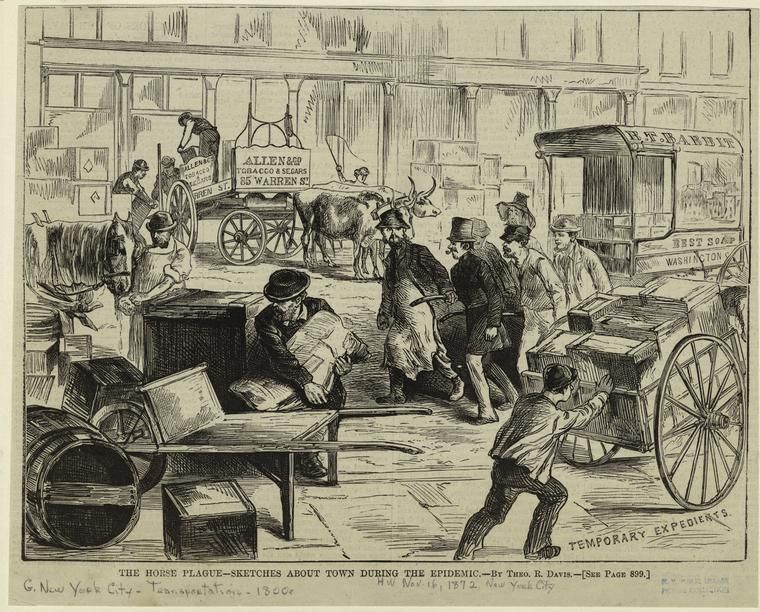
The epizootic spread across America from New England to California in only ninety days, and as far south as Havana, Cuba. It became known as the “The Great Epizootic of 1872.” Nearly 100% of horses in its path were infected, and between one and ten percent died. Most infected horses could not stand up, and when they could stand, they coughed violently. The disease rendered them unable to do any work, carry riders or pull wagons and carriages. All commerce ground to a halt as the most widespread and devastating equine flu epizootic in history took both Canada and the United States by surprise.

The coal needed to fuel locomotives could not be delivered. “The outbreak forced men to pull wagons by hand, while trains and ships full of cargo sat unloaded, tram cars stood idle and deliveries of basic community essentials were no longer being made.” The epizootic contributed to the financial panic of 1873, and it even affected the war in the West with the Apache Indians, where neither the Apaches nor the US calvary could use their horses and resorted to fighting on foot.

In November of 1872, a great fire broke out in Boston that destroyed 776 buildings across 65 acres of the city. Because of the epizootic, horses were unfit to pull the fire engines, hose reels and other fire equipment, so crews of men were organized to pull the heavy fire equipment on foot.

Newspaper headlines of the day reflected the widespread panic:  “Alarming Effect upon the People, Total Suspension of Travel, Disappearance of Wagons.” In October 1872, the New York Times reported:

There is hardly a public stable in the city which is not affected, while the majority of the valuable horses owned by individuals are for the time being useless to their owners. It is not uncommon along the streets of the city to see horses dragging along with drooping heads and at intervals coughing violently.

A few days later the Times reported:

Large quantities of freight are accumulating along the Erie Railway in Paterson, New Jersey. The disease is spreading rapidly in Bangor, Maine. All fire department horses in Providence, Rhode Island, are sick.

Everyday conveniences that had been taken for granted disappeared.

That a horse disease could cause such a nationwide catastrophe and contribute to a financial panic and prolonged financial downturn might be difficult for us to imagine. The Equine Flu epizootic of 1872 almost seems like a quaint, forgotten, historical footnote on how much things have changed, including our once-total reliance on draft animals. But this historical footnote begs an obvious question: Though we do not rely on horses today, have we become even more dependent on other forms of transportation that are totally dependent on a vulnerable fuel supply? Some people may be confident that our modern, global system is more resilient and robust than the draft animal–dependent system of the nineteenth century. But our modern system is much more fragile due to its ubiquitous dependence on one source of fuel that is almost completely out of our ultimate control, with 80 percent of our transportation fuel being imported.

From its very beginning, the Transportation Revolution of the nineteenth and twentieth centuries went hand in hand with the Industrial Revolution to completely reshape our economy and lifestyle, especially in the way food was supplied. This revolution began with the age of canals in the 1820’s, which radically lowered shipping prices. The age of canals was followed by the age of rail, which gave way to the age of highways after World War II. And now the Transportation Revolution continues with global shipping on container ships and dependence on oil tankers. In a previous issue we reported that the average American meal travels 1500 miles to the consumer, and many states grow as little as 15 percent of their food.

If the modern equivalent of the equine influenza epizootic were to strike, we are actually in a far more vulnerable place today than the America of 1872, which was still a largely agrarian economy with a rural population for which most food sources were local and therefore insulated from such a disaster.

CuChullaine O’Reilly, of The Long Riders Guild Academic Foundation, an organization which did a three-year research project on the equine influenza epizootic, concluded:

Imagine a transportation disaster that within 90 days affected every aspect of American transportation, everything Americans took [for] granted, everything that ensured their safety, every city, town and village where they lived and left everything in its path under siege.

At the height of the equine flu epizootic, in November 1872, a writer for the New York Times wrote:

What will be the effect of even a temporary withdrawal of the horsepower from the nation is a serious question to contemplate.  Coal cannot be hauled from the mines to run locomotives, farmers cannot market their produce, boats cannot reach their destination on the canals . . . .

Perhaps today, as the New York Times writer suggested one hundred and forty years ago from a greatly more self-sufficient and sustainable world, we also should seriously contemplate what we take for granted, and take the steps needed to provide sustainable resources for ourselves, our families and our communities.

Published in SustainLife Quarterly Journal of the Ploughshare Institute for Sustainable Culture (Fall 2012).


The Threshing Floor

Originally built in New Jersey circa 1810, this hand-hewn chestnut and oak timber frame barn is a unique cross of both Dutch and English framing styles.

If you are in Texas, consider a visit to our restored barns, cabin and showroom at at Homestead Craft Village. When you do, we feel you too will come to love and appreciate these historic monuments to fine hand craftsmanship and the simpler life they recall.